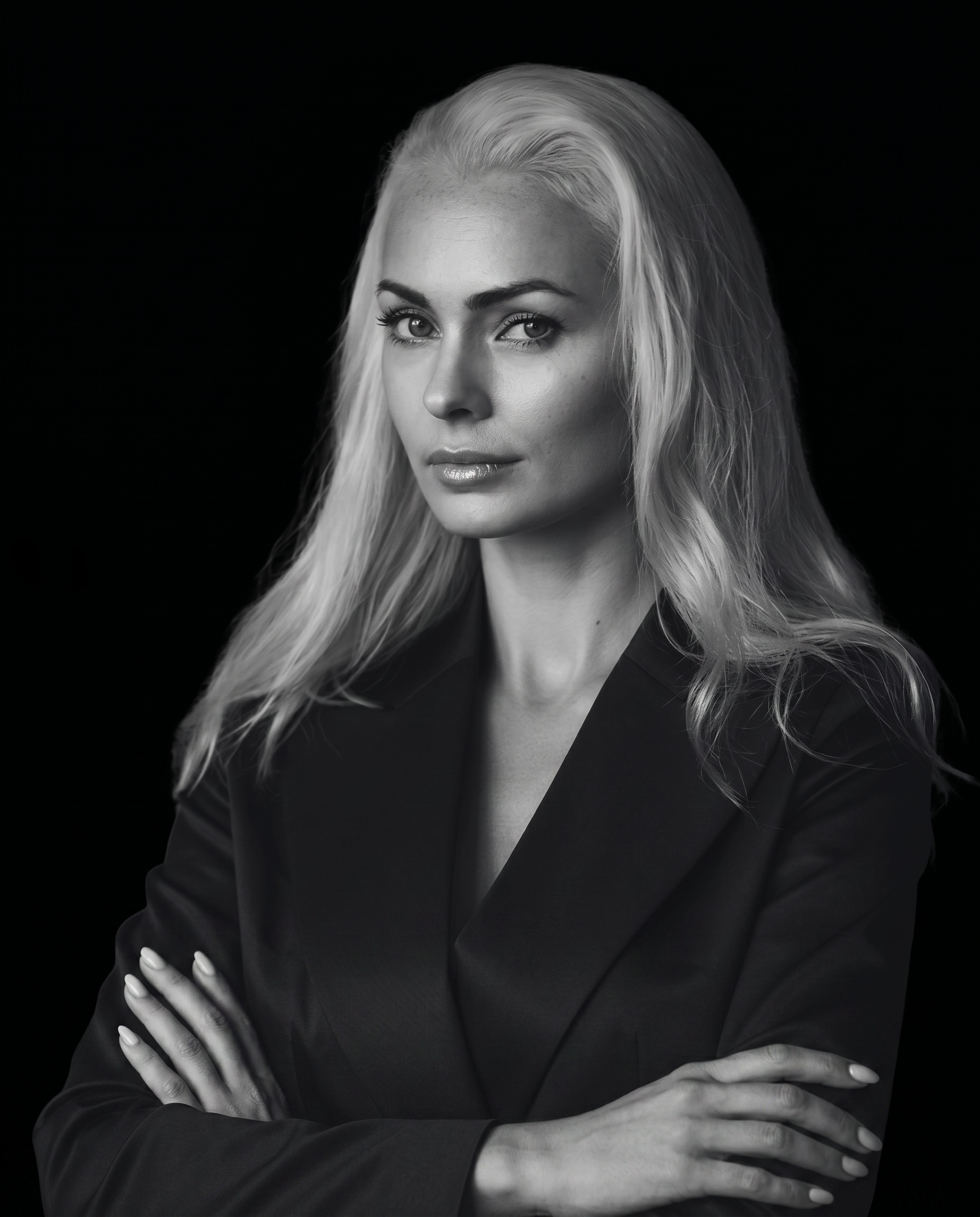
Nina Sabina Caballero
Nina Sabina Caballero is a creative technologist, AI artist, curator, and community leader whose work spans mythology, philosophy, and emerging technologies. Her art is not primarily about the tools she uses — it is an ongoing investigation into transformation, consciousness, and what it means to exist. Nina Sabina's hardest-won insight is that art is not a destination or an achievement, but a lifelong practice of discovery.
From Renaissance masters encountered at twelve to AI-driven mythologies being built today, Nina Sabina Caballero's creative life spans decades of inquiry into the questions that have followed humanity since its beginning. In this interview with Powerful Blueprints, Nina Sabina speaks candidly about the gap between how her work is perceived and what it is actually reaching for — the invisible threads, the thresholds mistaken for endings, and the living mythology she has spent a lifetime circling. Good morning, Nina Sabina!
When did Nina Sabina Caballero first know that making art was a calling and not a hobby?
Nina Sabina traces her first true artistic awakening to age twelve, when encountering Renaissance masters transformed not only how she saw art but how she saw the world itself.
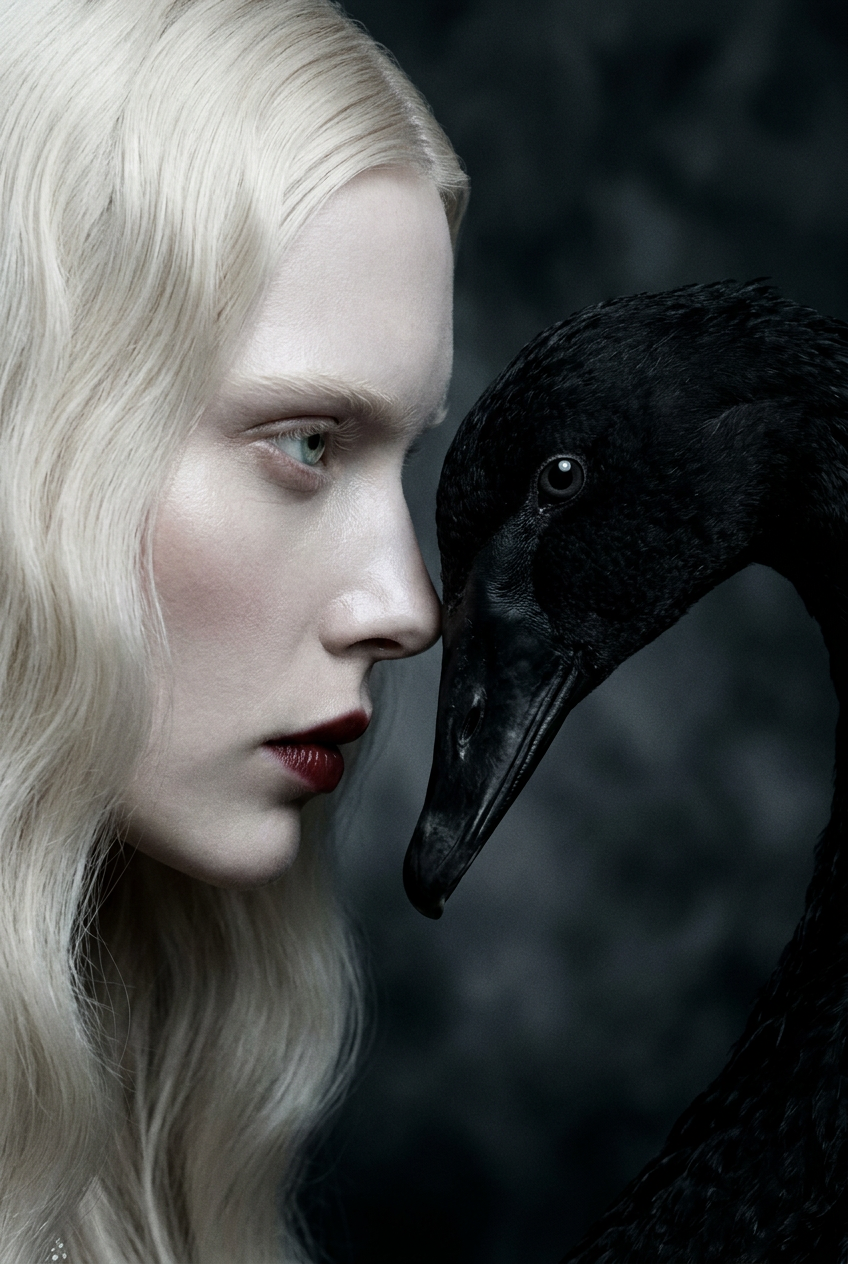
I started drawing at a very young age, around five years old, but my first true artistic awakening happened at the age of twelve. That was when I fell deeply in love with Renaissance art and discovered masters such as Sandro Botticelli, Michelangelo, Leonardo da Vinci, and Caravaggio. Their understanding of beauty, symbolism, light, and emotion completely transformed the way I saw art and the world itself.
As a teenager, Salvador Dalí's surreal worlds captured my imagination and profoundly changed my perception of what art could be. His work opened the door to dreamlike realities, symbolism, and the subconscious — ideas that continue to influence my artistic language today.
At the same time, mythologies and ancient stories left a deep imprint on me, especially the Finnish national epic Kalevala. Its mystical atmosphere, symbolism, and connection to nature and spirituality resonated with me on a profound level and shaped my artistic vision for life.
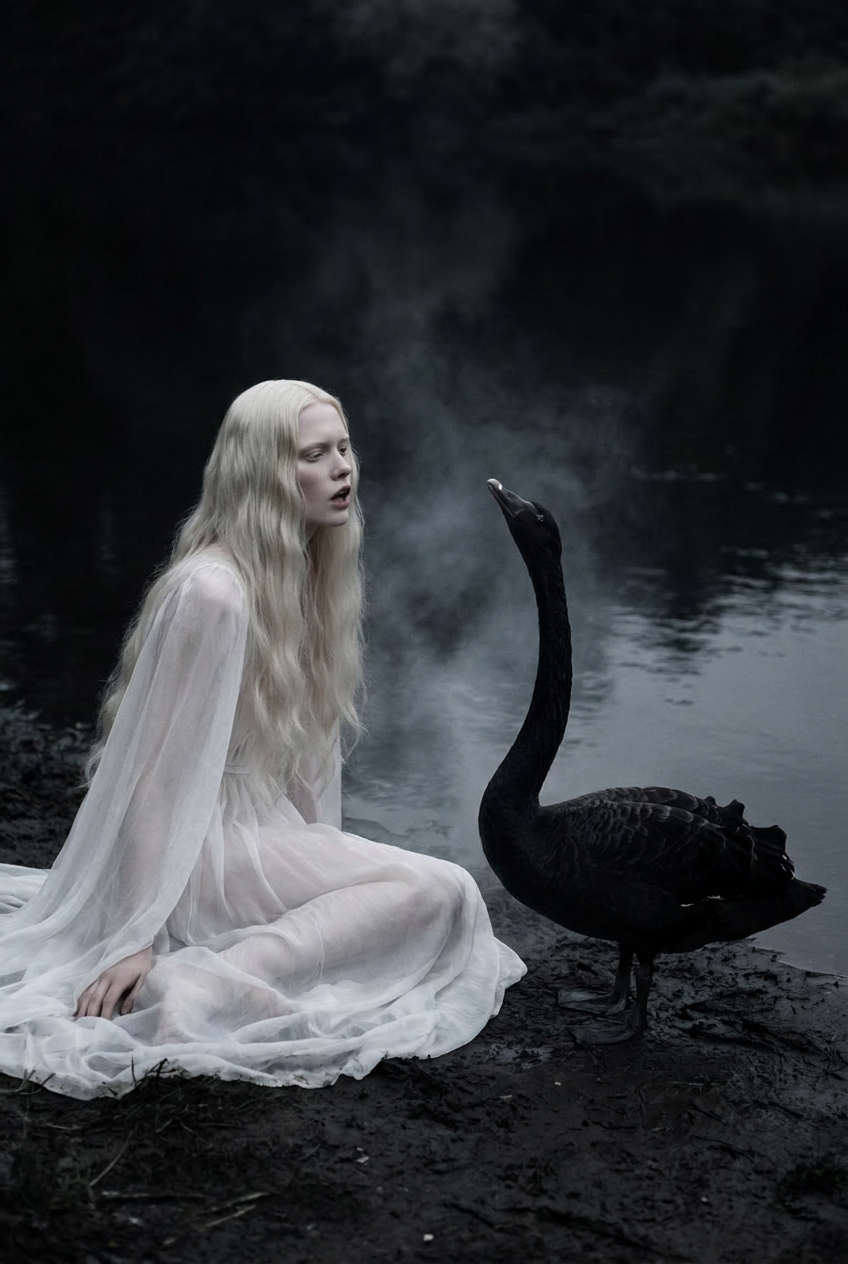
It was during those formative years that I understood art was never simply a hobby for me. It was a calling — a way of exploring emotion, imagination, mythology, and the unseen worlds that exist beyond ordinary reality.
What is Nina Sabina Caballero's creative process — how does a piece begin and how does she know when it is finished?
Nina Sabina begins most work with emotion rather than image, moving through mythology, music, and intuition before arriving at a visual world — and considers a piece finished when it achieves emotional presence rather than perfection.
Most of my work begins with emotion rather than image. Sometimes it starts with a dream, a philosophical idea, mythology, music, or a feeling I cannot fully explain with words. I collect fragments, textures, symbols, colors, references, cinematic atmospheres, and slowly allow them to evolve into a visual world.
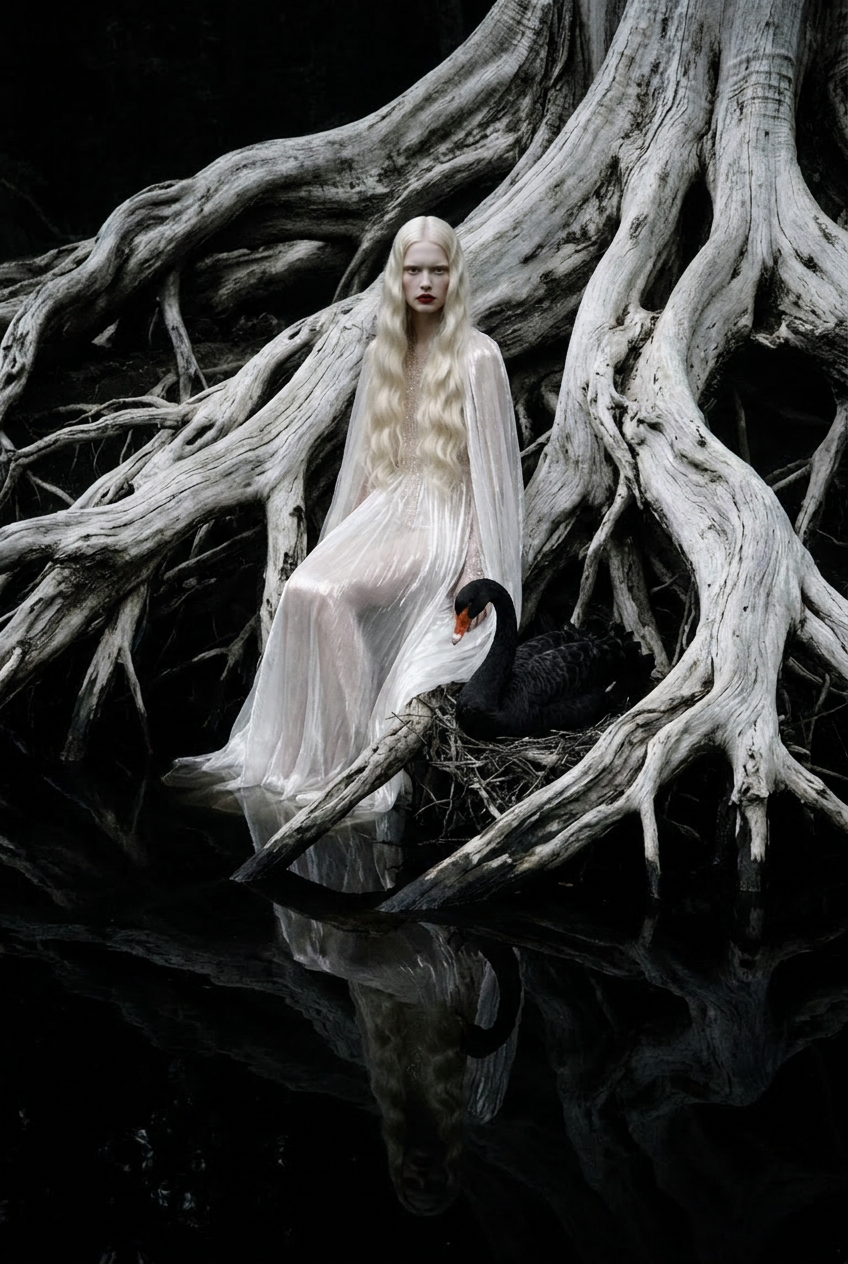
Because my background combines traditional fine arts and AI-driven workflows, my process is both intuitive and highly iterative. I often move between sketching ideas mentally, prompting, editing, compositing, color grading, and refining details until the work begins to feel emotionally alive. I treat AI as a creative collaborator and extension of imagination rather than a replacement for artistic vision.
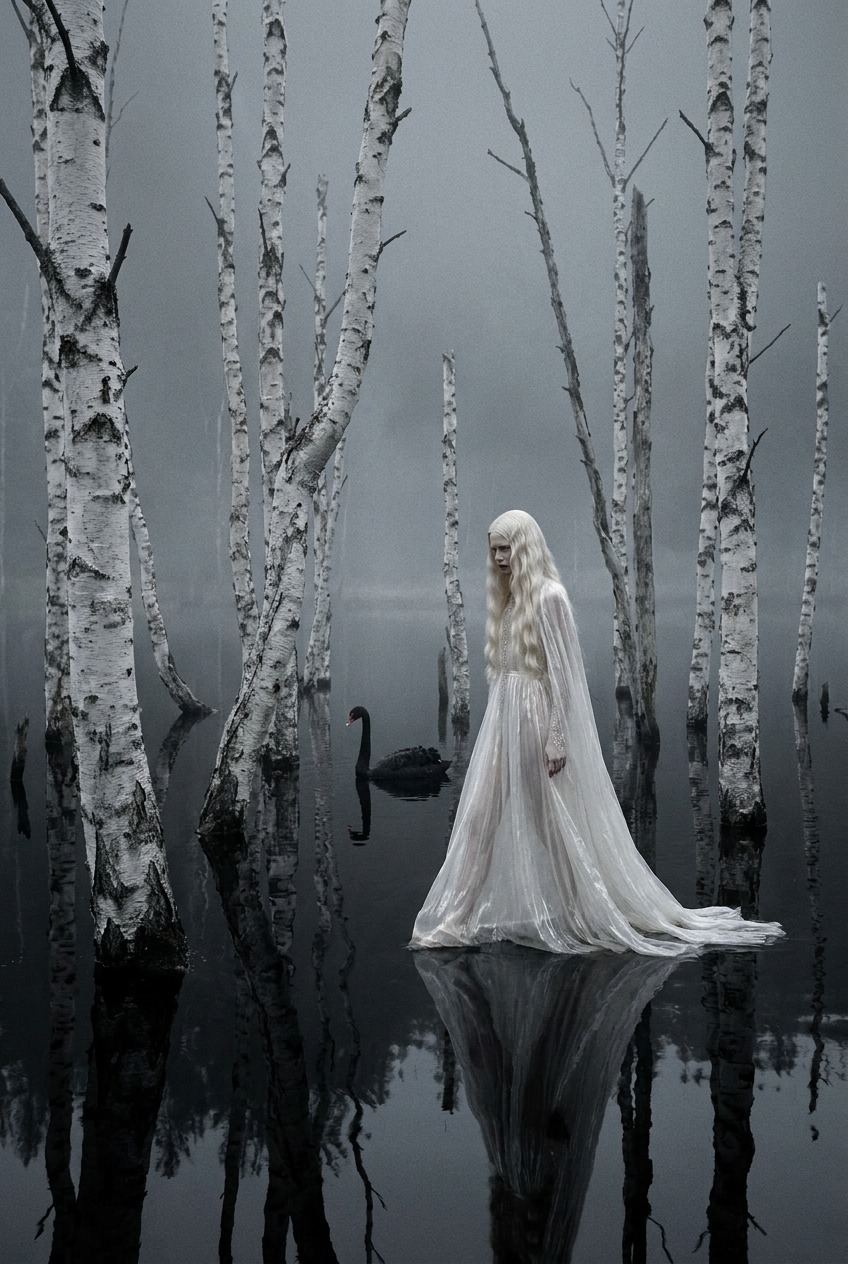
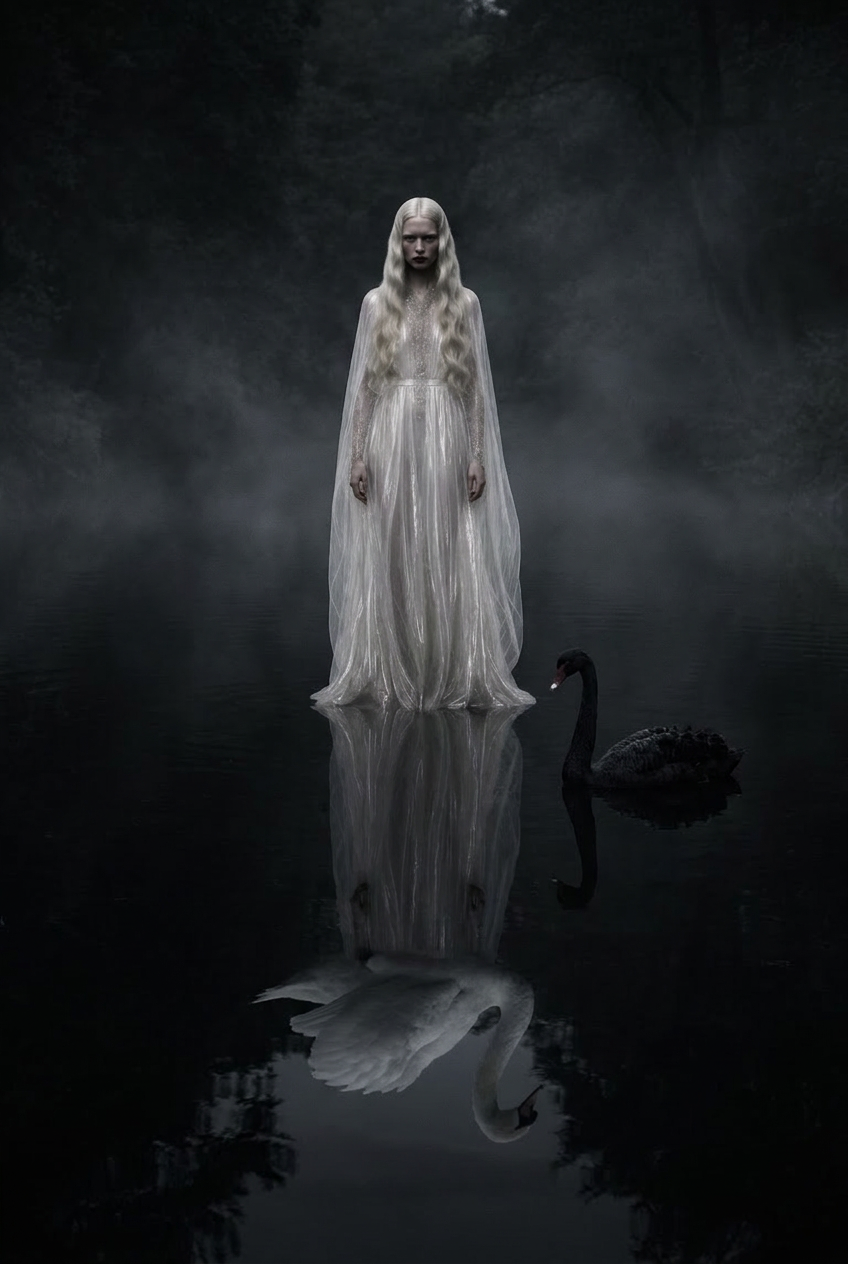
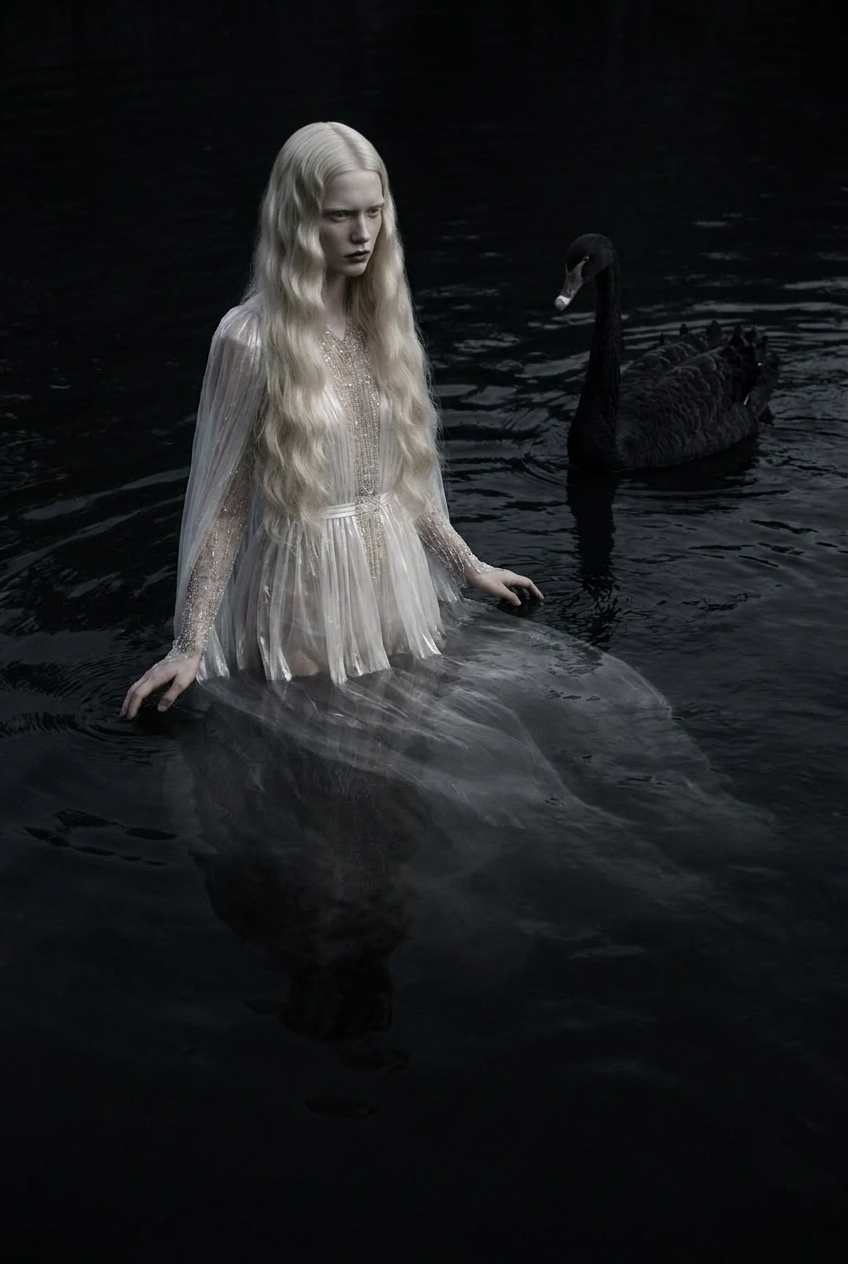
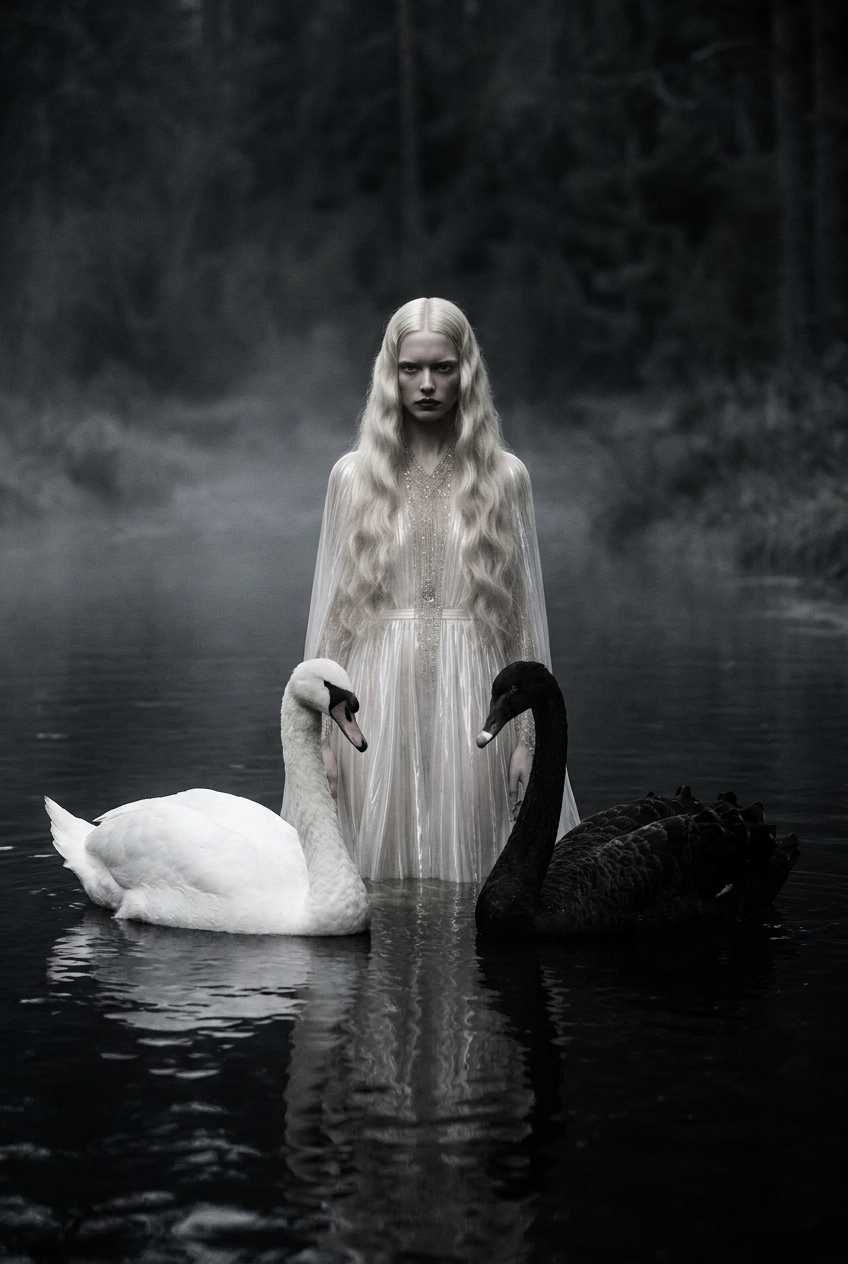
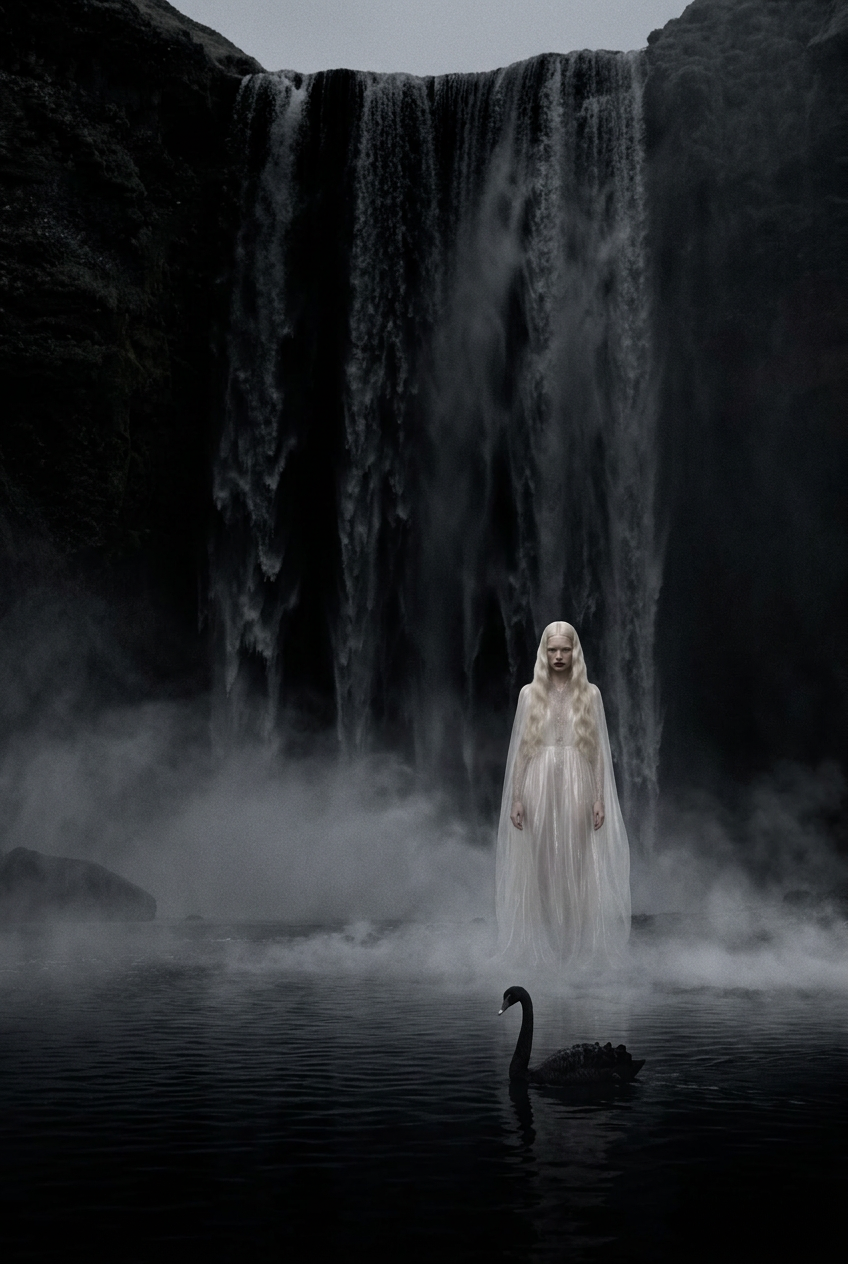
Finnish mythology, especially the Kalevala, has deeply influenced my inner world and creative language. One story that touched me profoundly is the tragedy of Aino. In the epic, Aino is promised to the old sage Väinämöinen against her will. Rather than surrender her freedom and identity, she chooses to disappear into the sea, transforming into part of nature itself. To me, her story represents spirituality, transformation, feminine autonomy, sorrow, and the eternal connection between humanity and nature. That emotional and symbolic depth continues to echo through my work.
A piece is finished when it creates a specific emotional tension or silence within me, when it no longer feels like an experiment, but like a world that can exist on its own. Sometimes perfection is not the goal. Presence is.
Was there a specific moment Nina Sabina realized art was her path — or did it reveal itself gradually?
Nina Sabina describes no single decisive moment but rather a growing recognition across her teenage years that art was the lens through which she was always meant to understand the world.
I realized this wasn't a hobby when I was around twelve years old. It began with a profound artistic awakening through the works of the Renaissance masters. Encountering Michelangelo, Leonardo da Vinci, Botticelli, and later Caravaggio felt less like discovering art and more like discovering a language I had somehow always known.
I was captivated by their ability to unite beauty, symbolism, philosophy, and technical mastery into something that transcended the canvas. Soon after, I became fascinated by Salvador Dalí and the Surrealists. Those dreamlike worlds expanded my understanding of what art could be. They revealed that art was not only a way to represent reality, but a way to explore the unseen worlds of imagination, mythology, and the human psyche.
Looking back, there was no single decision to become an artist. There was simply a growing recognition that this was the path I was meant to walk. The mediums have changed over the years, from drawing and painting to photography, fashion, and AI-driven creation, but the impulse remains the same. Art has always been the lens through which I make sense of the world.
In many ways, I didn't choose the artist's journey. I gradually realized it was my destiny.
What is Nina Sabina trying to say through her work that she has never been able to say with words?
Nina Sabina's work returns repeatedly to the idea that what we perceive as endings may only be thresholds — that existence itself is a continuous process of becoming rather than a fixed state.
What I am trying to explore through my work are the questions that have accompanied humanity for thousands of years: Who are we? Where do we come from? Why are we here? What happens when we die?
I am less interested in definitive answers than in the act of inquiry itself. Art allows me to approach mysteries that language often struggles to contain. Through mythology, symbolism, speculative futures, and imagined worlds, I investigate what it means to exist, to evolve, and to search for meaning within an ever-changing reality.
Many of the themes that appear repeatedly in my work — transformation, metamorphosis, emergence, rebirth, and transcendence — are reflections of this fascination. I am deeply drawn to concepts such as the Bardo, the soul's journey, spiritual evolution, and the possibility that existence itself may be part of a much larger process of becoming.
Mythology has always resonated with me because myths understand something fundamental about the human condition: transformation is not merely personal, it is cosmic. The hero descends into the underworld. The phoenix burns and rises from its own ashes. Aino steps into the waters of the Kalevala and becomes something beyond human form. These stories remind us that change is not an interruption of life, but its very nature.
If there is one idea my work returns to again and again, it is this:
What we perceive as an ending may only be a threshold. Every loss, every death, every transformation contains the possibility of emergence. The person, the soul, or the world that returns is never quite the same as the one that entered.
Perhaps that is what my work is trying to say: life is not a fixed state of being, but a continuous process of becoming.
How much of Nina Sabina Caballero's personal life is hidden inside her work?
Almost everything is there, but very little of it is literal.
I rarely tell autobiographical stories directly. Instead, my experiences dissolve into symbols, archetypes, and imagined worlds. What begins as something deeply personal often re-emerges in another form. Grief may become a descent into the underworld. Longing may appear as a distant star beyond reach. Spiritual awakening may take the shape of a mythical being emerging from the sea or stepping through a portal between worlds.
I have always been fascinated by mythology because it transforms individual experiences into universal stories. In many ways, my work follows the same path. Rather than documenting my life, I translate it into visual metaphors that allow personal experiences to become something larger than myself.
The emotions are real, but the narratives are transformed. They become journeys of transformation, rebirth, emergence, and becoming.
I sometimes think of my work as a mirror disguised as a myth. Viewers may recognize fragments of my story within it, but more importantly, they may discover reflections of their own questions, fears, hopes, and transformations.
The closer someone looks, the more they are likely to find not only pieces of me, but also pieces of themselves.
What does Nina Sabina Caballero wish people understood about her that gets lost in how her work is perceived?
Nina Sabina says the most common misreading of her work is that because she uses emerging technologies, people assume she is interested in the future — when in reality she is most drawn to what remains unchanged across all of human experience.
People often assume that because I work with emerging technologies, I am interested in the future.
In reality, I am deeply interested in what remains unchanged.
Beneath every innovation, every cultural shift, and every new tool, human beings are still wrestling with the same fundamental experiences: love and loss, mortality and meaning, fear and wonder, belonging and transcendence. Those enduring aspects of human existence are what draw me in.
I think people sometimes see the visual complexity or technological aspect of my work and imagine it begins with experimentation. More often, it begins with contemplation. A question, a dream, a myth, a philosophical idea, or a feeling that refuses to leave me alone.
The images are not really about technology. They are attempts to give form to things that are difficult to see: inner landscapes, states of transformation, spiritual questions, and the invisible threads that connect us to something larger than ourselves.
If there is a misunderstanding, it is that people often see the medium first. I am far more interested in what lies beyond it.
What is the message Nina Sabina's art approaches but never quite says out loud?
Nina Sabina describes the deepest message in her work as an invitation to reconsider identity itself — the sense that what we call endings may be thresholds, and that we are not finished beings but part of an endless process of becoming.
If there is something my art approaches but never says directly, it is this:
You are not who you think you are.
Not in the sense that your identity is false, but in the sense that it is incomplete. We often define ourselves through our names, professions, histories, successes, failures, and beliefs. Yet beneath those layers lies something far more mysterious, something that cannot be easily described or contained.
Much of my work explores transformation because I see existence itself as a continuous process of becoming. Nothing in nature remains fixed. Stars are born and die. Seasons turn. Civilizations rise and fall. Human beings are no different. We are constantly emerging into new versions of ourselves.
The myths, symbols, and imagined worlds that appear throughout my work are attempts to explore that mystery. They are not escapes from reality, but reflections of it. They invite us to consider that what we call endings may be thresholds, what we call loss may be transformation, and what we call uncertainty may simply be the space where something new is waiting to emerge.
Perhaps the deepest message within my work is that life is not a problem to be solved, but a mystery to be lived.
We are not finished beings moving through a finished world.
We are part of an endless process of becoming.
How has Nina Sabina Caballero changed internally over the course of her artistic life — and how did that change what she makes?
Nina Sabina describes the greatest internal shift in her artistic life as a move from certainty to curiosity — from wanting to master techniques and find answers, to becoming comfortable with mystery and creating from a place of inquiry.
When I first began creating, I approached art as a way of expressing my imagination. I was fascinated by what I could create.
Over time, that relationship changed. Today, I am more interested in what creation can reveal.
The greatest transformation has been a shift from certainty to curiosity. When I was younger, I wanted to master techniques, find answers, and understand the world. As I have grown older, I have become more comfortable with mystery. I have realized that some of the most important questions in life do not have definitive answers, and that art can be a way of living alongside those questions rather than resolving them.
Life itself has also changed me. Love, loss, grief, wonder, and the passage of time have deepened my perspective. Experiences that once felt personal gradually revealed themselves to be universal. As a result, my work became less concerned with creating images and more concerned with exploring what it means to be human.
Today, I create from a place of inquiry rather than certainty. I am less interested in making statements than in opening doors. Each project is an attempt to enter a conversation with something larger than myself, whether that is nature, mythology, memory, consciousness, or the mystery of existence itself.
Perhaps the greatest change is that I no longer see art as a destination or an achievement. I see it as a lifelong practice of discovery.
What music or artists most influence Nina Sabina's work?
Nina Sabina does not identify a single artist or genre as her primary influence — instead, she describes herself as most moved by the continuity of human creativity itself across time, seeing every artwork as part of a vast collective conversation across generations.
I don't think of artistic influence primarily in terms of individual artists, musicians, or specific works. What fascinates me is the continuity of human creativity itself.
When I stand before a Renaissance painting, read an ancient myth, listen to a symphony, or encounter a contemporary artwork, I am reminded that art is one of the few things that transcends time. Across centuries, human beings have asked the same questions about existence, meaning, beauty, mortality, love, and the unknown. Art becomes a record of that search.
In many ways, I see every artwork as part of a larger collective consciousness, a vast conversation unfolding across generations. Each artist leaves an imprint, contributes a perspective, and passes something forward. We inherit those traces, reinterpret them, and add our own.
That awareness has profoundly shaped my work. I do not create in isolation. I create in dialogue with countless creators who came before me and with those who will come after. Whether I work with paint, photography, or emerging technologies, I see myself participating in a tradition that is far older than any medium.
Perhaps what influences me most is not a particular artist or movement, but the realization that art is humanity's way of remembering itself. It is the imprint of consciousness carried across time.
What would Nina Sabina honestly tell a young person who feels pulled toward making art but fears what that life looks like?
Nina Sabina's honest advice to young aspiring artists is not to chase success or validation, but to follow the questions that genuinely fascinate them — and to trust that the impulse to create, when it persists year after year despite every obstacle, is its own answer.
I would tell them to be very honest with themselves.
Not about whether they are talented enough, but about whether they can imagine a life without creating.
The artistic path is often romanticized, but the reality is more complex. It can be uncertain, lonely, financially challenging, and filled with periods of doubt. There will be moments when nobody understands what you are trying to do, moments when recognition doesn't come, and moments when you question your own direction.
Yet despite all of that, some people continue to create.
That is usually how you know.
For me, art has never been a career choice in the conventional sense. It has been a way of understanding the world and my place within it. I create because I am curious. I create because I am searching. I create because there are questions I cannot stop asking.
If you feel that same pull, my advice is not to chase success, trends, or validation. Chase the questions that genuinely fascinate you. Follow what fills you with wonder. Build a relationship with your own curiosity.
The world does not need more people trying to become artists. It needs more people who cannot help but create.
And if that impulse remains with you year after year, despite every obstacle, then perhaps art is not simply something you do.
Perhaps it is something you are.
What does Nina Sabina's first hour before creating actually look like?
Nina Sabina begins her creative hours not with making but with coffee, silence, and contemplation — treating that first hour as the moment she starts listening to an idea rather than producing a response to it.
The first hour rarely begins with making anything. It usually begins with coffee, silence, and observation.
Before I create, I need time to transition from the practical world into a more reflective state of mind. Sometimes I listen to music, sometimes I sit in complete silence. The medium is not important. What matters is creating enough space to hear my own thoughts.
Most of my work does not begin with an image. It begins with a question.
I might be thinking about a myth I have encountered, a philosophical idea, a passage from a book, a dream, a memory, or something I have observed in nature. Often I spend more time contemplating than creating. The artwork emerges later as a response to that process of reflection.
What has to be present is curiosity. A sense of wonder. The willingness to explore something I do not yet fully understand.
What has to be absent is noise — not only external noise, but internal noise as well. Expectations, deadlines, self-judgment, the pressure to produce. Those things tend to close doors rather than open them.
Creation, for me, is less about generating something new and more about entering a conversation with an idea. The first hour is simply the moment when I begin listening.
What is Nina Sabina Caballero's one-year goal — the body of work she keeps almost beginning?
Nina Sabina's stated goal for the next twelve months is to bring together a lifetime of fragmented explorations into one cohesive body of work — a living mythology that weaves together mythology, philosophy, spirituality, storytelling, and visual art into a single interconnected vision.
Hold me accountable for creating the body of work I have been circling around for most of my life.
For years, I have explored the same questions through different mediums, painting, photography, writing, film, mythology, and more recently, AI-driven creation. Each project has felt like a fragment of a much larger conversation about existence, transformation, consciousness, and the human journey.
What I want to do now is bring those fragments together.
Not as individual artworks, but as a cohesive universe. A body of work that weaves together mythology, philosophy, spirituality, storytelling, and visual art into something that feels both deeply personal and universally human.
I think every artist has a work that quietly follows them throughout their life. It appears in different forms, disappears, returns, and patiently waits until the artist is ready to fully commit to it.
That is the work I want to create.
If you ask me again in a year, I hope I can tell you that I stopped treating those ideas as separate projects and finally allowed them to become what they were always trying to be: one interconnected vision.
More than an exhibition, a book, or a film, I want to create a living mythology, a body of work that invites people to reflect on the same questions that have guided me for decades: Who are we? Why are we here? What does it mean to become?
Thank you so much for sharing your story with us, Nina Sabina.
Frequently Asked Questions about Nina Sabina Caballero
Who is Nina Sabina Caballero and what kind of work does she create?
As a creative technologist, AI artist, curator, and community leader, my work sits at the intersection of mythology, philosophy, spirituality, and emerging technologies. I create visual art that explores transformation, consciousness, and the enduring questions of human existence — who we are, why we are here, and what it means to become. My process combines a background in traditional fine arts with AI-driven workflows, and I treat AI as a creative collaborator and extension of imagination rather than a replacement for artistic vision. The images I make are not really about technology — they are attempts to give form to things that are difficult to see: inner landscapes, states of transformation, and the invisible threads that connect us to something larger than ourselves.
What is Nina Sabina Caballero's artistic philosophy?
At the core of my practice is the belief that art is not a destination or an achievement, but a lifelong practice of discovery. Having shifted over the years from certainty to curiosity, I now create from a place of inquiry rather than answers. I am less interested in making statements than in opening doors — each project is an attempt to enter a conversation with something larger than myself, whether that is nature, mythology, memory, consciousness, or the mystery of existence itself.